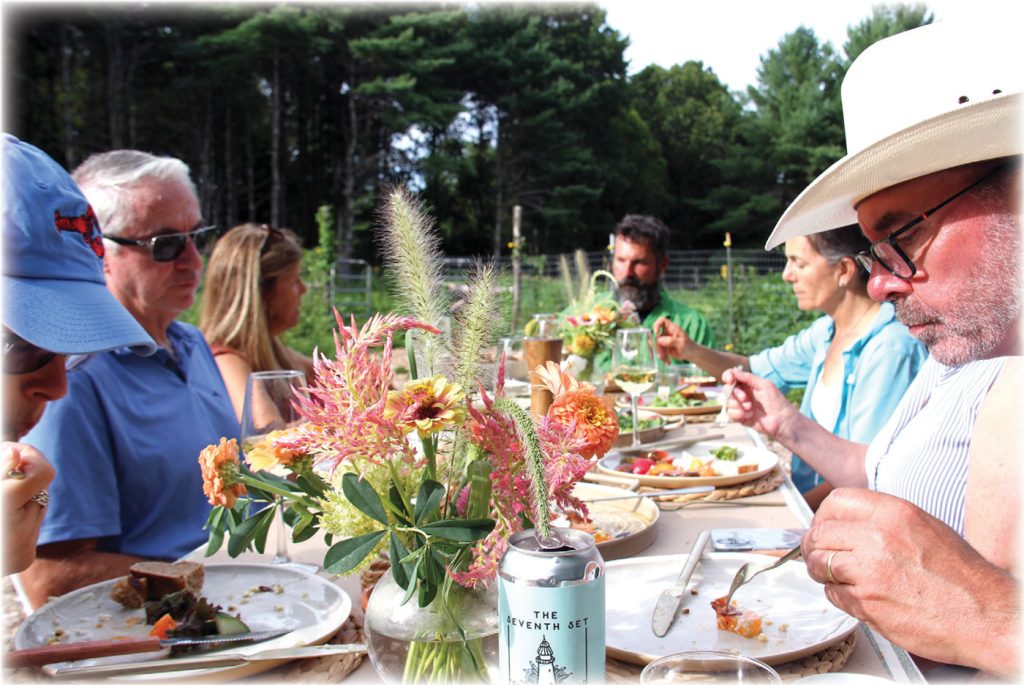
At the head of the table, Fowl Play Farms’ Brett Sovick and Amanda Maximchuk (blue shirt) and their regeneratively grown produce and proteins take center stage at an on-farm dinner prepared and presented by H. Cole.
Taste probably factors into your food-buying decisions. And you probably buy local, in-season food because it tastes “better.” But why? Sometimes to know these things, you have to go back to the source. I met with a local farmer and a chef to get answers.
Brett Sovick and his wife Amanda Maximchuk own Fowl Play Farm in Duxbury. On roughly ten acres, they grow vegetables, maintain beehives, and raise livestock, including laying and meat chickens, quail, and geese. Fowl Play is a regenerative farm founded with the idea that there are not enough good tasting, nutrient-dense food options, and with the goal of creating a resilient system.
Regenerative agriculture is a holistic farming approach that restores soil health, enhances biodiversity, improves water quality, and sequesters carbon. By mimicking natural processes—such as minimizing tillage, covering soil, rotating crops, and rotating livestock through inactive produce areas—this system reverses degradation, builds ecosystem resilience, and ensures long-term farm viability while improving overall soil health.
Brett explains that regenerative farming translates to nutrient-dense food “because all the nutrients are loaded right into the soil matrix and the soil microbial community. The soil microbial community is doing biochemical things to help fortify the plants and the animals that are growing on the land.” One of the challenges of regenerative agriculture is that things take a little more time. But with time you’ve got a system that’s producing resilient, nutrient-dense food. “We saw that this last season with the produce that we grew on the field with no [additional fertilization] inputs,” said Brett.
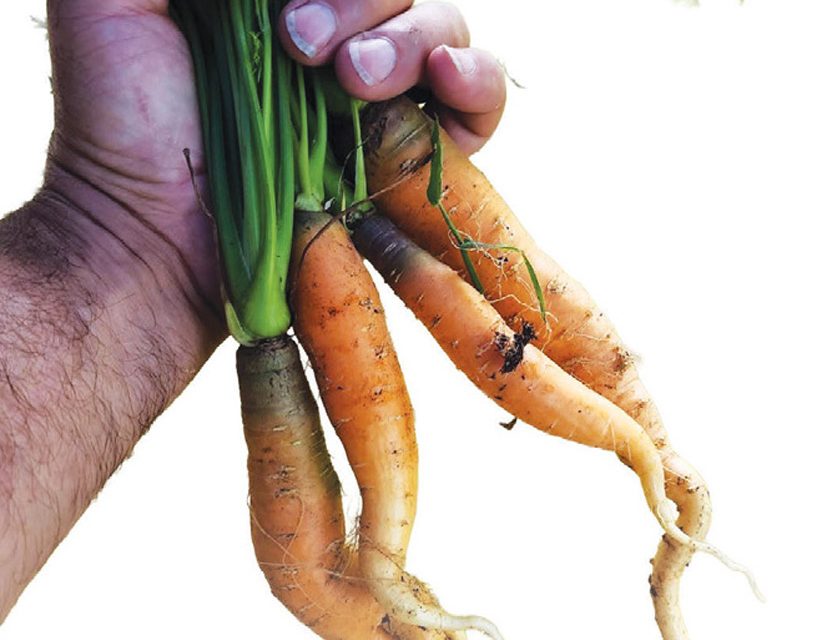
Consider the carrot.
Brett explains that the industrial carrot, grown solely to look a certain way and appeal to grocery store shoppers, is different from those on his farm. At large industrial farms, “they come in, they seed, and then they dump whatever chemical on it to feed the plant. That chemical doesn’t stick around in the soil very long.” The carrot grabs what’s provided to grow big and fat. “In addition, a lot of the plants that they’re using are very, very rapidly growing plants. They’re not the same kind of seed that we plant here. They’re getting plants or seeds that are more industrialized, built for one thing: rapid growth.” These carrots do not allow for the development of the flavor matrix. “That’s why it doesn’t taste as good as our carrots.”
Or consider the chicken.
Brett holds out his hands as if passing me a chicken. “I just tell [a prospective customer], here, take the chicken, it’s free. Go to the grocery store, buy one and compare them. I feel like a drug dealer because people come back and they’re like, ‘There’s such a huge difference.’”
The carrot from Brett’s farm looks different, in part because it may be a different type of carrot and in part because of how it is grown. The chicken coming off Brett’s farm looks different from what you might buy at the grocery store. It is probably fresher and has a pinker hue to it. But what about taste? Does food from a regenerative farm taste better?
To get an answer, I spoke with local chef Jessica Fox.
Jessica became a chef at age five. “I’d be outside playing with a big stock pot. I would put water from the hose and a little bit of dirt, so it looked like broth. And then I’d walk around my yard and put plants in it and make like a stew.”
She worked in restaurants during high school and college, earned a degree in Cultural Anthropology studying the intersection of food and culture, and then a Master’s in Food Studies and Gastronomy with a Certificate in Culinary Arts. She also worked as a private chef.
Jessica knows a thing or two about food.
Jessica does not disagree with Brett’s carrot example but offers a different one to illustrate taste: the tomato. “If you’re eating a tomato from the grocery store out of season versus a regeneratively grown heirloom tomato in season, fresh off the farm, I mean, the flavor is just going to be insanely different.” The flavor will be better, the texture different, and even how you prepare it may vary.
Chickens also serve to make the point. She explains that the primary breed used for meat chickens is the Cornish Cross. So, the chicks that Brett and Amanda raise at Fowl Play are similar to the chicks delivered to the large chicken producers.
“But they are going to taste different.” And that’s the result of what Brett and Amanda are doing. “[The chickens] have been eating a really healthy nutrient-dense diet. They’re getting plenty of food scraps and vegetables that maybe they harvested just a bit too late to sell at the market, but the chickens are going to love them, right?
Plus, she adds, the chickens are living a good life, doing what chickens do, out in the open, picking at the ground and getting a good diet. All of that translates to better taste and texture. How food tastes is a function of the nutrients it was provided for growth and how it was raised, its terroir, the unique combination of environmental and human factors that gives a food its distinctive flavor.
But there is more to it.
Jessica continues, “I think our perception of flavor is far more nuanced than we assume, and it starts way before we think it starts. I’ve worked at Fowl Play Farm helping them process chickens and quails on several occasions. And then I’ve used those same chickens to cook a big meal and serve it to folks on the farm. For me, the spiritual connection to the food, to the land, and to the animals is so important. The amount of care that goes into this food is what makes it so much more enjoyable, so much more nourishing. It is nourishing on a level way beyond just the nutrient density or even that momentary perception of flavor.”
Contributing to the flavor is our experience with how the food came to be on our plate and in our mouth. We go to the farm-stand and talk to the farmer. And then, back in our kitchen, we prepare the meal. Our brains recall all the sensory input associated with the food as we prepare and eventually consume it. It’s not just the experience of sitting down to a plate; it’s all that you bring to it. “I believe that the energy put into our food before we consume it factors into our experience of it more than the perceived flavor itself.”
“It’s nourishing on a soul level.”
Maybe that is why it tastes so good.