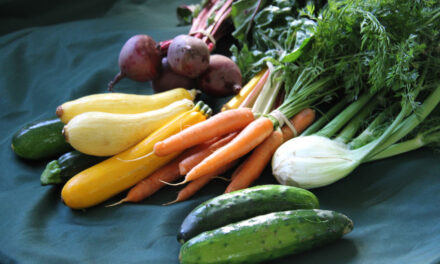
Pulling off to the side of the road to pick up a few ears of corn strewn on an old card table, perhaps some tomatoes, zucchini, and summer squash, or maybe eggs, has always been such a satisfying experience in my travels. I miss the fields of butternut squash of my childhood, fields now lined with houses, green lawns, and ornamental trees. Yes, progress happens, people need a place to live, I get it. But there is something so charming about a roadside farm stand where you quietly purchase your goods by dropping money in an old coffee can. Thankfully, some farms have been able to hang on through the years and transform their land amid these ever-changing times of “progress.”
Two Centuries of Family Farming
Family-owned for seven generations, The King Farm in South Dartmouth has been operating for seven generations, with three family members currently residing on the 120-acre farm. The farmhouse sits along the sprawling acreage, with a small network of dirt roads leading to fields filled with crops, greenhouses, silos, and a dairy barn. Up the path towards the house is a rusted-out tractor that, in season, is covered with juicy mulberries. Both men and women have taken on the leadership roles of this family farm since its founding in 1852. For perspective, that’s one year after Moby Dick was published, when whale oil was on the decline, and the rise of fossil fuel was beginning to usher in an industry that agrarian farms—small family-owned farms that rely on manual labor, primarily from family members—have had to adapt to throughout the years.
Through thick and thin, The King Farm held its own through the evolution of farming in the industrial age. That the farm has endured for over 200 years is a living testament to resilience and stewardship. What began as a simple homestead was gradually shaped by each generation, which faced challenges unique to their time. Some were forced to sell a portion of the land to weather financial strains, yet the farm grew into a thriving dairy operation that sustained the community for decades. Later, a portion of the property was taken by eminent domain, prompting a determined fight to safeguard what remained. That effort led to placing the land under an Agricultural Preservation Restriction through a Massachusetts program that helps ensure the land will remain protected for farming. Today, the farm continues to thrive by welcoming the community onto its grounds, transforming its legacy into a vibrant marketplace that honors the past while sustaining the future.
Dan King, now at the helm of The King Farm, states that “to usher in a modern appeal and become less stagnant, the farm has to adapt a strategy different from that of 150 years ago.” Returning to the agrarian style of farming, Dan has transformed the family farm into a “hub” of fresh, local, and regionally sourced foods. Sure, you can still get your seasonal favorites, but nowadays, you can get a whole lot more at a roadside farm stand.
 Agri-science + Collaboration
Dan knows where it’s at. He was once the procurement manager for the Coastal Foodshed, an organization that coordinates sales and distribution of local food grown across Southcoast Massachusetts to make it available equally to everyone on the South Coast. Dan now goes further by reaching into the Northeast and Western regions of Massachusetts to source food, branching into Vermont, New Hampshire, and New York, then right back down into the Southern part of New England to include Connecticut and Rhode Island. Dan works with food hub businesses such as Marty’s Local, Meyer’s Produce, Coastal Food Shed, and Farm Fresh Rhode Island. These businesses aggregate local food from farms and food producers throughout New England and the Northeast.
For example, Dan often works with Meyer’s Produce and Marty’s Local in the western part of the state. These two small, trusted, decentralized food aggregators share the same mission and values as The King Farm: work hard to link and connect the regional food system to increase farmers’ access to markets; grow local businesses; and provide a platform for creative economies that make fresh, healthy, and nutritious foods easily accessible to folks, versus food coming from thousands of miles away. The system not only promotes sustainable agriculture but also protects the farmland from being developed into housing lots and corporate businesses. Dan sources through the vetted vendors to bring fresh produce home to the farm.
A provisioner’s provisioner, one might say of Dan. Dan says The King Farm and market “serve as a bridge from growers and makers to customers and eaters.” The selection of artisanal foods in and around Massachusetts is an intentional choice made by Dan. There are site visits, tastings, research, and knowing the history of the business itself that result in lining the shelves at the farm stand, and that is by King’s design. The number of products and producers grow every year. In 2024, over 140 farms and purveyors partnered with King Farm. Local favorites include Heart Beets Farm in Berkley, Under the Sun in Dighton, Westport Dairy, and Flying Carrot Farm in Dartmouth (for some of the best eggs ever). Also worth mentioning is Ground Up Grains from Holyoke—as someone who teaches folks how to use local food, I can attest that these products are exceptionally good for making pasta and baked goods.
The approach taken by The King Farm is less about competition and more about collaboration and partnership. Every farm, grower, and maker has something to offer. Derek Christianson, owner and farmer of Brix Bounty Farm says, “What I grow complements what Dan offers at the farm.” Derek operates the four fields and the five greenhouses located on The King Farm property. Investing his time and energy into the science of the soil, Derek produces nutrient-dense vegetables using the Brix scale—a method for knowing when foods are just ripe enough, before they begin breaking down into sugars. He is meticulous in producing delicious and fresh produce. A popular vendor at the New Bedford Farmers’ Market in the summer, Derek also sells his produce in the blue shed on The King Farm through an honor system by dropping money into a wooden box.
Extending the Farmers’ Reach
Along with the science of farming, there is the art of making food. Shopping at large corporate supermarkets disconnects the customer from the personal relationship between the local farmer and the customer. One small and growing business jumped out at me when I read the name “Mr. Tamole,” a clever play on words interweaving the word mole with tamale—two foods this Boston-based company is known for. Brilliant marketing, I might add.
The King Farm also sells Butterfly Bakery Mustards and Goat Milk Caramel from Fat Toad Farm, both from Vermont. Fresh breads from Navad Bakery in Rhode Island, Craic hot sauce from Lowell, MA, and very local wildflower honey from Alderbrook Farm to smear on the Rustic Crumbs sourdough bread from Dartmouth—just a stone’s throw away. It doesn’t get any more local than that! I spoke to Jennifer Kite, the artisan behind Rustic Crumbs, a home-based and licensed micro bakery. Jen specializes in sourdough bread and makes a full line of baked goods, including scones and English muffins. I have it on good authority that Jen usually drops off at The King Farm around 9 am on Fridays. You’ve been warned—so get it while it’s hot, or at least still warm. A testimonial to The King Farm’s importance in the food system community—Jen’s sales have increased, allowing her to focus on her micro bakery full-time, with more to come in the very near future.
The Farm Stand tent is open for in-person shopping March– December, daily from 9 am to 6 pm, online shopping with pickup services year-round, and a micro market in the blue shed is open Friday to Monday in January and February.
The King Farm has a much larger selection than the familiar “card table” of days gone by—one that is meant to highlight and uplift the local businesses and farmers that make small batch goods from quality fresh ingredients. To keep the food tasting fresh from farm to table, it truly takes an entire system to support the mission. No longer does the farm have to go to market as it did in the years before mechanized farming. Now, customers come to the farm.
The farm has come full circle, no doubt, but this time around it encompasses creative communities that reach beyond the South Coast into urban cities and surrounding regions. The charm of New England is now home and host to a world of people, tastes. Long-standing traditional recipes as well as clever new ones and trustworthy methods—all result in products that find their way into the jars, boxes, and bags that line the shelves or are placed strategically near your favorite vegetables—now available year-round at The King Farm.
The King Farm
441 Bakersville Road
South Dartmouth, MA 02748
(508) 972-5391
TheKingFarm.com
Rhonda M. Fazio is an artist, traveler, and creative curator of Interwoven, an artist venue in New Bedford. Specializing in food and fabric, she is currently making jams for Dan’s Farmstand. www.rhondamfazio.com