by Rhonda M. Fazio.

Have you ever looked at the inside of a clam shell in its entirety? A littleneck or cherrystone, top-neck, or the mighty Quahog, all come from the same Mollusca class known as bivalves—a hinged, two-part shell. Clams lack a central nervous system and therefore have no brain. They live in tidal pools of mud where they are dug or raked over easily by seagulls and humans alike. Clams can live up to five hundred years, which we can tell by counting the lines on their outer shell, like the rings of a tree.
Native American Quahog/Wampum history here
Local Primer
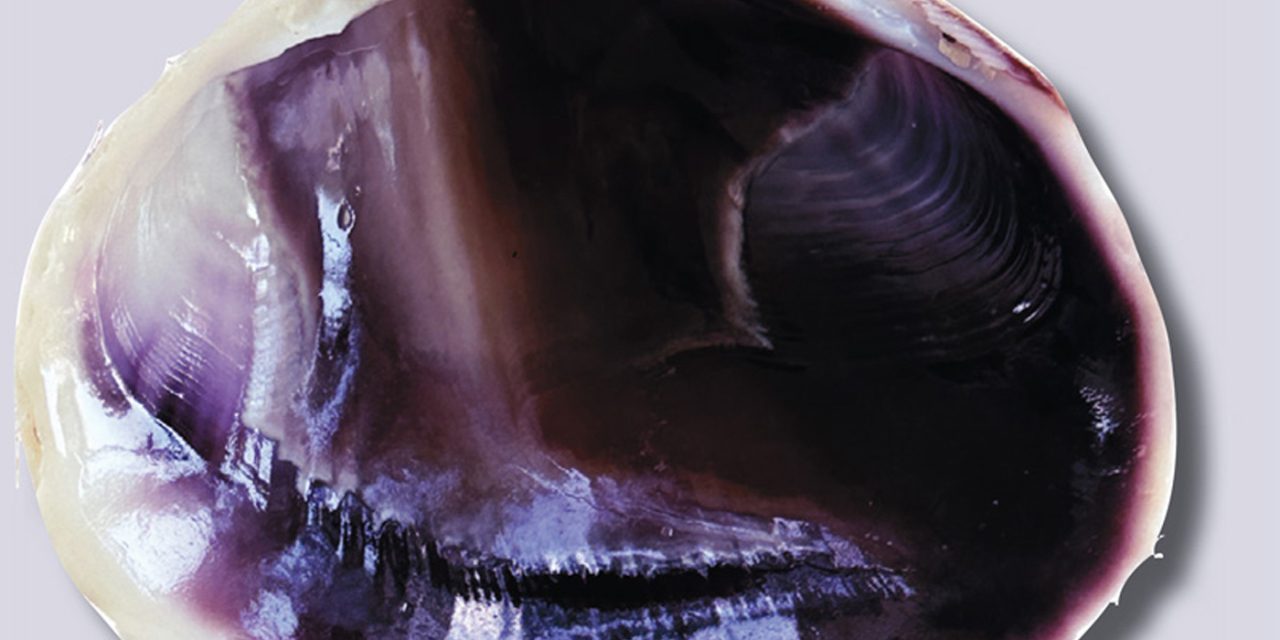
Mollusca are beautiful creatures, with unique characteristics of shape and form—think of the nautilus, scallop, and mussels with a range of color from the soft iridescent hues of abalone to the vibrant intensity of the “blue ringed octopus.” Stunning. Are there any colors more mysterious and soothing than the deep purple and lavender of the inside surface of a hard-shell clam? Known for their use in currency and ceremony in early colonial history, in the scientific realm, they are known as Mercenaria mercenaria. The insides are just as intriguing; the body of a clam is delectably delicious. Commonly known today as “stuffies,” stuffed quahogs, baked clams, clams oreganata, or clams casino. All these variations involve surrounding a clam with breadcrumbs, but it truly depends on which state you are in to understand the differences.
- Add some onion, herbs, and spices, mix in chopped clams, and you are in Rhode Island.
- If you use chouriço, onions, peppers, and spices, you are standing in two states: Rhode Island and Massachusetts.
- If you keep the clam whole and top it with breadcrumbs seasoned with oregano, garlic, and olive oil, and finish with a squeeze of lemon, you are in New York.
- If you top it with bacon and chopped peppers, you are at a casino in Narragansett, Rhode Island, and eating a dish favored by the wealthy in the era of the Gilded Age.
“Stuffies” became a thing in the early 20th century in Rhode Island. The origin is credited to Italians and Portuguese reinventing dishes from their homelands on a new shore. If you say “stuffie,” you are from Rhode Island; if you say “stuffed quahog,” you are from Massachusetts. Quahogs in cuisine moved around the Northeast quicker than they ever could in the sand, which is a little over an inch in fifteen minutes.
Searching for Treasure
The deep purple of the shell is iconic. I have been combing the beach for quahogs since childhood. I’ve amassed quite a collection of shells during my years. The pounding of the surf produces the most beautiful bits of smooth shells with purple and white stripes. One day, I found an entire shell that, in my eyes, looked like a “crazy quilt” pattern. Tinted with the deepest strips of purple, stripes of lavender, and white parenthetically placed like it was nestling the fleshy body that was once inside, made me realize I could never use this shell to hold my baked clam filling. It is too beautiful.
Why is this clam shell so purple when so many others are not? It has to do with minerals in the sandy mud. Aragonite, another form of calcium carbonate that makes up the shell of a quahog, interacts with the surrounding impurities and the diet of the clam to create these colors. Who knew? The same ocean, along the same coastline, different beaches with an array of minerals, all reacting with the alkaline base of a clam shell. Its position on the pH scale creates the color purple. Looking back, what was once a mystery now makes so much sense and reminds me of my first steps becoming an artist who works with color. Looking at the assemblage of shells strewn about my living and workspaces brings me right back to when I discovered them, sometimes to the exact place.
The fondest memories I have of my childhood are going to the beach with my Sicilian family to dig for clams. We would pack up and pile into the wood-paneled station wagon every Sunday morning (church was on Saturdays in the summer), making our way to the beach. Once there, we would follow my dad into the water to search for quahogs. Summer after summer we would eat, not like kings and queens, but like the peasants we were (and some of us still are). Years later, I would teach my son and his friends how to dig for clams, passing down the family tradition that began in the waters of the Mediterranean so long ago. The following recipe is inspired by that lineage.
Recipe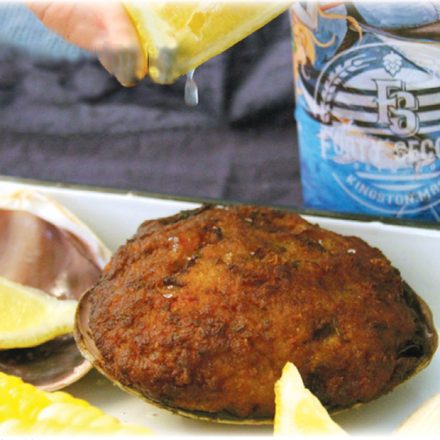
Baked Clams on the Half Shell
Ingredients
- 12 raw top neck quahog clams (Be sure all the clams are closed. If the shells are open, they are not safe for consumption—though you may want to save the shell for its color Scrub the excess mud off the clam and rinse.)
- 2 teaspoons of salt
- 2 quarts of water
- 2 tablespoons of corn meal
- 1 tablespoon of butter
- 1 tablespoon olive oil
- 1 shallot minced
- 1 whole garlic clove
- 1 cup of breadcrumbs (Italian seasoning or plain) or Ritz crackers if preferred
- 1 teaspoon freshly chopped flat-leaf parsley
- Salt and pepper to taste
- Hot pepper flakes if desired
- One lemon (to include 1 teaspoon of lemon juice and 6 lemon wedges)
- 1 to 2 sprigs of flat-leaf parsley
Instructions
- Soak the clams in a saltwater solution of 2 teaspoons of salt, two quarts of water, and 2 tablespoons of corn meal for 30 to 60 minutes.
- Put clams in a bowl with fresh, running water to rinse.
- Place the clams in a skillet with an inch or two of water, cover, and simmer until the clams open, 5 to 10 minutes. Remove and allow to cool.
- Save the clam juice from simmering and pour into a large jar or measuring cup, allowing the sediment to settle. Set aside.
- In a skillet on medium heat, melt 2 tablespoons of butter and olive oil gently. Do not let it burn or smoke. Add minced shallot and 1 whole garlic clove, sauté to translucent, then remove garlic clove. Add 1 cup of breadcrumbs and toast lightly (Italian seasoned or plain). Add clam juice to moisten as needed, ¼ cup at a time to avoid making a soggy mess.
- Freeze the remainder of the clam juice for another recipe.
- Mix and season with salt and pepper to taste.
- Add hot pepper flakes if desired.
- Assemble the clam shells on a baking sheet by separating the shells, keeping the whole clams intact. With a knife, release the muscle if needed, and place the clams in a small bowl.
- Season with a light drizzle of olive oil, 1 tablespoon of lemon juice, a pinch of salt and pepper, and 1 teaspoon of freshly chopped flat leaf parsley. Toss to coat and place in shells. Top with breadcrumbs to evenly distribute the crumbs and bake for 20 to 25 minutes or until golden brown and toasty.
- Serve with one fresh lemon wedge per plates and top with a sprinkle of fresh parsley.